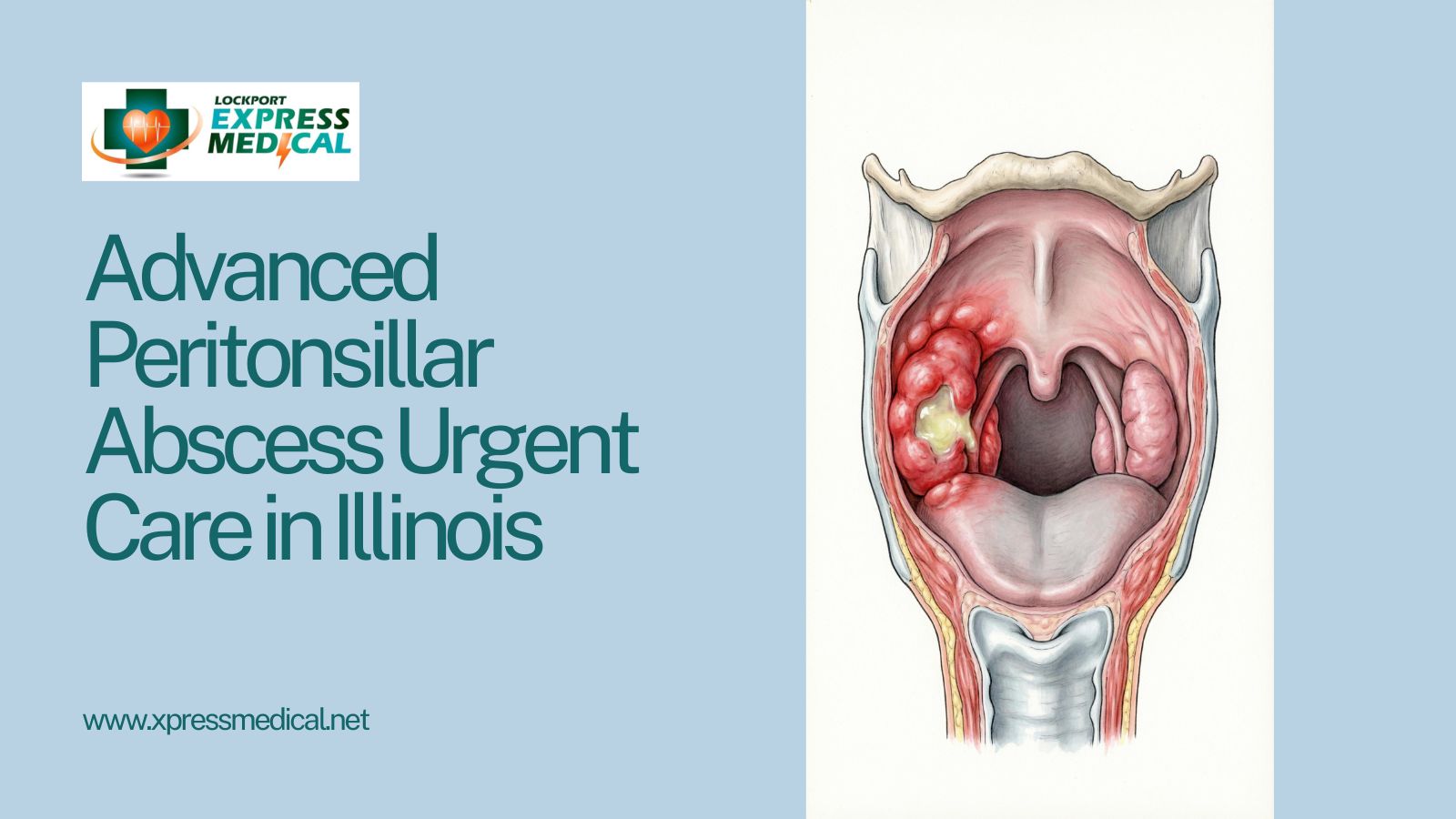
A peritonsillar abscess can begin with what feels like a bad sore throat, then change quickly. Pain often settles on one side, swallowing becomes harder, and the voice may sound thick or muffled. Peritonsillar abscess urgent care allows the clinician to check the airway, hydration, mouth opening, and swelling around the tonsil. At Lockport Express Medical, the first goal is to recognize danger early and arrange the right peritonsillar abscess treatment, including hospital or specialist care when drainage is needed.
What is a peritonsillar abscess?
A peritonsillar abscess happens when pus collects in the tissue beside one tonsil. It usually develops after a tonsil infection spreads beyond the tonsil itself. The swelling is often one-sided, so the throat may look uneven and the small flap in the middle, called the uvula, can shift quite noticeably.
People often notice pain that is much worse on one side, sometimes reaching the ear. Swallowing may feel difficult, the voice can sound muffled, and the jaw may not open normally. In simple terms, it is a deeper pocket of infection, not just an inflamed tonsil or a sore throat.
What are peritonsillar abscess causes?
- A peritonsillar abscess usually starts when a bacterial infection in a tonsil or the nearby throat spreads into the soft tissue beside it. It often follows tonsillitis, though some people do not remember having a clear earlier episode.
- The infection is rarely caused by one germ alone. Streptococcus and Staphylococcus may be involved, along with anaerobic bacteria that normally live in the mouth and throat.
- Smoking and gum disease can raise the risk. A previous peritonsillar abscess also makes another episode more likely, so past history matters during evaluation.
- Older children, teenagers, and young adults are affected most often. Repeated tonsil infections may give bacteria more chances to move beyond the tonsil and form a pocket of pus.
- At peritonsillar abscess urgent care, symptoms, mouth opening, throat swelling, and infection history are reviewed together. The likely cause helps shape the medical management of peritonsillar abscess, including antibiotic coverage and whether drainage or specialist care is needed without an unnecessary delay.
Explore: Fast Urgent Care for Sore Throat for Medical Attention
When consider a peritonsillar abscess urgent care?
- One-sided throat pain can change fast. It may start like tonsillitis, then become much sharper, reach the ear, or make swallowing feel strangely difficult.
- Listen to the voice. A thick, muffled sound, drooling, bad breath, or a jaw that barely opens can mean swelling is building beside the tonsil.
- At peritonsillar abscess urgent care, the immediate questions are practical: Can the person drink? Can they swallow saliva? Is breathing still easy? The throat and neck are checked for uneven swelling and uvula movement.
- Peritonsillar abscess imaging is not automatic. Ultrasound or CT may be considered when the examination is unclear or deeper spread is suspected.
- Do not wait for urgent care when someone is gasping, turning blue, confused, or unable to swallow saliva. Call emergency services. Even without those signs, worsening fever, weakness, very little urine, or steadily increasing one-sided pain deserves assessment that day, because drainage, antibiotics, fluids, or specialist care may be needed without further delay or guesswork.
Explore: Get Urgent Care For Angina Patients Near Lockport IL
Difference between strep throat and peritonsillar abscess:
| Strep throat | Peritonsillar abscess |
| Often starts quickly with fever, painful swallowing, red tonsils and tender glands at the front of the neck. | Often feels more one-sided and may get worse after a throat infection has already started. |
| Pain is usually felt across the throat. White patches may appear, but they do not prove an abscess. | Pain is usually stronger on one side and may shoot toward the ear on the same side. |
| The voice may sound normal or slightly changed because the throat is sore. | The voice may become muffled, and opening the mouth can become difficult or painful. |
| A rapid strep test or throat culture helps confirm the infection before treatment is chosen. | Uneven swelling, drooling, uvula shift or trouble handling saliva suggests infection has moved beyond the tonsil. |
| Usually treated with antibiotics when strep is confirmed. | Often needs antibiotics plus drainage, because a formed pocket of pus may not empty with medicine alone. |
| Worsening pain should not be ignored, especially if symptoms are changing quickly. | Rapidly worsening one-sided pain, drooling or trouble swallowing saliva needs same-day assessment. Breathing trouble, blue lips or confusion needs emergency care. |
How Do Doctors Treat a Peritonsillar Abscess?
- The doctor may begin by watching the patient talk and swallow. Drooling, noisy breathing, or an inability to sip water can change the plan before the throat is even examined.
- Looking inside the mouth, the doctor checks whether one side is fuller, whether the uvula has shifted, and whether jaw pain is limiting the view.
- In peritonsillar abscess urgent care, a needle is sometimes used to see whether the swelling contains pus. Bedside ultrasound can guide that step. CT is more useful when infection may have traveled farther into the neck.
- A confirmed pocket usually needs drainage. Peritonsillar abscess treatment also includes antibiotics, pain control, and fluids; some patients receive medication for swelling when the clinician thinks it will help.
- Afterward, nobody is sent home just because pus was removed. The patient needs to drink, breathe comfortably, and manage saliva. Continued dehydration, worsening swelling, immune suppression, or concern about deeper infection can mean ENT assessment, IV therapy, observation, or admission.
Explore: The Best Walk in Clinic for Pneumonia in Lockport IL
Can a Peritonsillar Abscess Be Prevented?
- No method can guarantee prevention, because an abscess may appear after tonsillitis or without a remembered throat infection. Still, reducing exposure to the viruses and bacteria behind tonsillitis can lower risk.
- A throat infection that keeps worsening deserves another look. Take prescribed antibiotics exactly as directed, and do not rely on leftovers from an older illness or stop once the fever fades.
- Mouth care matters more than many people realize. Brushing, flossing, treating gum disease, and avoiding smoking or vaping may reduce the bacterial load and remove two known risk factors.
- At peritonsillar abscess urgent care, new one-sided pain, earache, jaw stiffness, or a muffled voice can be checked before swelling becomes harder to manage.
- Someone who has already had an abscess should mention it at every throat visit. Repeated tonsillitis or another abscess may lead peritonsillar abscess specialists, usually ENT doctors, to discuss tonsillectomy after recovery. That decision depends on recurrence, age, general health, surgical risk, and personal preferences too.
Explore: Professional Urgent Care for Respiratory Illness in Illinois
Why choose Express Medical for peritonsillar abscess urgent care?
- Lockport Express Medical offers walk-in visits every day, which helps when one-sided throat pain becomes worse after an office has closed. No routine appointment is required.
- The visit is not just a throat swab. The clinician also listens to the voice, checks jaw opening, looks for uneven tonsil swelling, and asks whether water or saliva can still be swallowed.
- A rapid strep result may explain part of the illness, but it cannot show whether pus has collected beside the tonsil. That distinction changes the next step.
- At peritonsillar abscess urgent care, the provider can judge whether the patient appears stable enough for outpatient care or needs immediate ENT or hospital assessment.
- Any peritonsillar abscess medication is chosen around the findings. Antibiotics may treat the infection, while pain relief and fluids support recovery. A formed abscess, however, often needs drainage. Breathing difficulty, drooling, marked dehydration, or suspected deep-neck spread should be escalated promptly rather than managed as an ordinary sore throat.
Conclusion
A sore throat should not be ignored when the pain becomes sharply one-sided, swallowing grows difficult, or the voice suddenly sounds muffled. Visiting peritonsillar abscess urgent care can help clarify whether the problem is tonsillitis, surrounding inflammation, or a pocket of pus that needs specialist treatment. The clinician can also determine whether peritonsillar abscess medication, fluids, pain control, drainage, or hospital care may be required. At Lockport Express Medical, worsening throat symptoms can be assessed promptly. Trouble breathing or an inability to swallow saliva, however, requires immediate emergency care.
FAQs
What does a peritonsillar abscess feel like?
Most people describe a sore throat that is far worse on one side. Swallowing may feel almost impossible, and the pain sometimes reaches the ear. As the swelling builds, the voice can sound thick or strange, and even opening the mouth wide may become difficult.
What is the early stage of a peritonsillar abscess?
It does not always begin as an obvious pocket of pus. The first clue may simply be a throat infection that is getting worse instead of settling, especially on one side. Fever, pain under the jaw, an unpleasant taste, or increasing trouble swallowing can follow.
How urgent is a peritonsillar abscess?
It should be checked the same day. Waiting gives the swelling more time to interfere with swallowing or spread into nearby tissues. A peritonsillar abscess urgent care visit can help when breathing remains normal.
Is a peritonsillar abscess the same as strep throat?
No, strep throat infects the throat and tonsils, while an abscess is a trapped collection of pus beside a tonsil. Both can bring fever and painful swallowing, but marked one-sided swelling, ear pain, a muffled voice, or difficulty opening the mouth points more strongly toward an abscess.