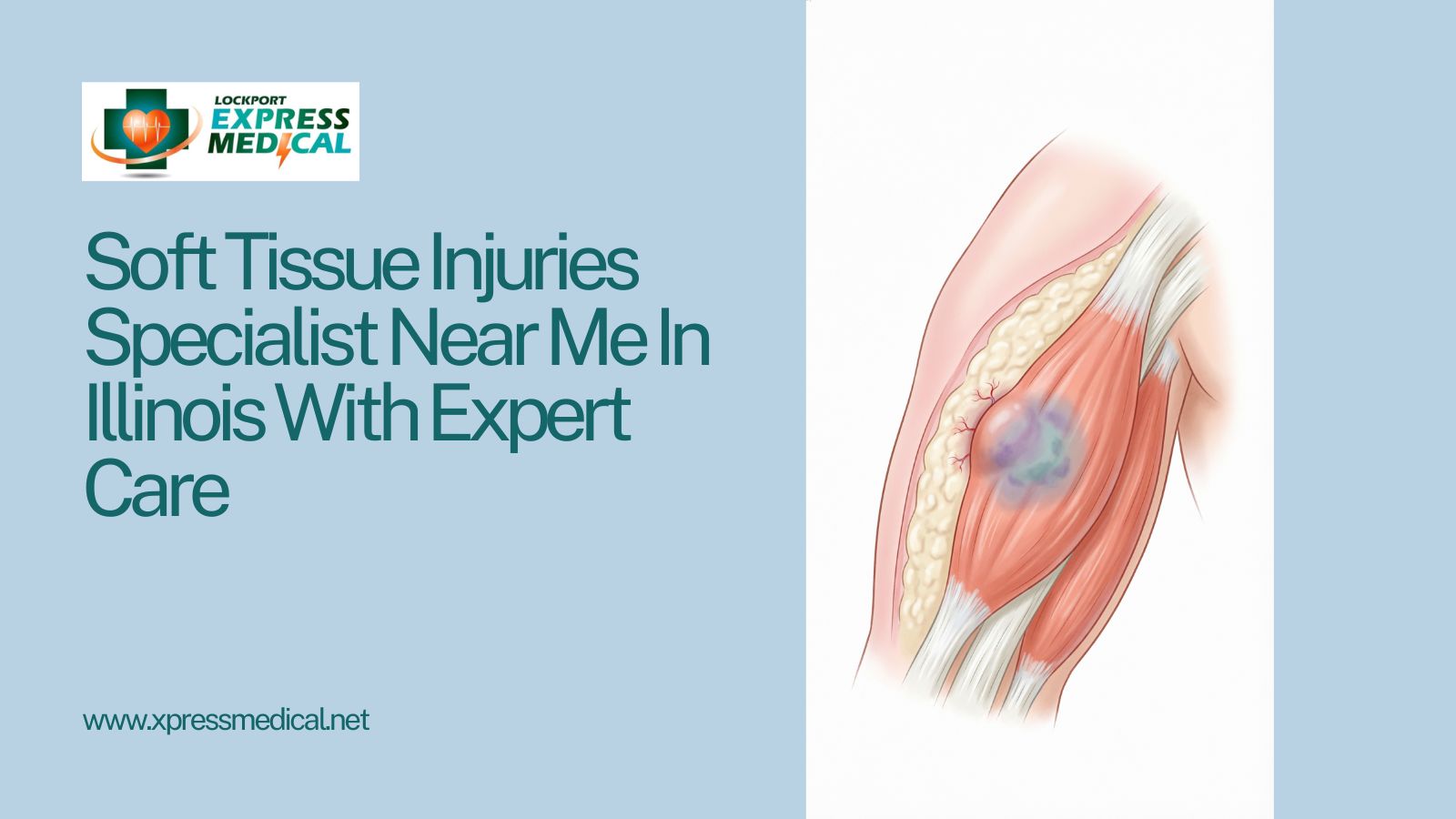
People often search for a soft tissue injuries specialist near me after an injury that looked minor at first but is still causing trouble days later. An ankle may remain swollen after a wrong step, or a shoulder may hurt every time the arm is lifted. These injuries can affect muscles, ligaments, tendons, and the tissue around a joint. Pain alone does not always show how much damage has occurred. At Express Medical, patients in Illinois can have the injured area examined, rule out problems such as a fracture or deeper tear, and receive advice that fits the injury rather than relying on rest alone.
What are soft tissue injuries and its symptoms ?
- A twisted ankle, a pulled hamstring, and a bruised thigh are all soft tissue injuries, although they do not behave in the same way. Ligaments are hurt by twisting, muscles by forceful stretching, and tendons by sudden load or repeated use.
- Pain is only one part of the picture. Swelling may restrict a joint before bruising appears. A muscle tear can cause cramping or loss of power; tendon damage often hurts when the muscle works against resistance. With ligament injury, the joint may feel unreliable rather than simply sore.
- Symptoms that keep building after the first day deserve attention, especially when walking, gripping, or lifting becomes harder. Numbness, a cold limb, or increasing swelling needs urgent assessment.
- A soft tissue injuries specialist near me can separate a minor injury from damage that needs imaging or follow-up. Management of soft tissue injuries is matched to function, while recovery time for soft tissue injuries depends on injury depth and return to movement.
Types of soft tissue injuries and causes:
- A sprain follows a joint being pushed too far. The ligament may be overstretched or torn after a missed step, awkward landing, or change of direction. Strains are different: they involve muscle or tendon and are common after lifting, sprinting, or reaching beyond the body’s usual range.
- A direct hit causes a contusion. The skin may stay intact, but bleeding develops underneath it. Repeated friction or pressure can irritate a bursa, while repeated pulling on a tendon can lead to tendinitis. These problems build over time rather than after one clear accident.
- Some injuries are linked to work rather than sport. Repetitive gripping, carrying uneven loads, long hours in one position, poor footwear, and returning to activity before strength has returned can all keep the same tissue under stress.
- A soft tissue injuries specialist near me looks at how the injury happened before recommending treatments for soft tissue injuries, because a sudden tear is managed differently from an overuse problem.
Get Urgent Care X Ray at Express Medical
Soft tissue injuries specialist near me: Urgent signs
- A wound over the palm, wrist, ankle, or top of the foot needs more than a look. Tendons sit close to the surface in these areas, so a small cut can interrupt movement even when bleeding is slight.
- Rapidly increasing pain, a limb that feels tight, or pain that is far worse than the injury raises concern for pressure building inside the muscle compartment. That is an emergency because blood flow and nerve function can deteriorate.
- Medical review is needed when a bruise keeps enlarging, forms a firm mass, or appears without a reason, particularly in anyone taking warfarin, apixaban, clopidogrel, or another blood thinner.
- This is where finding a soft tissue injuries specialist near me becomes important: the examination can separate a simple injury from tendon disruption, infection, internal bleeding, or compartment syndrome.
- The best medicine for soft tissue injury depends on what is present. Painkillers alone are not enough when there is a deep cut, expanding hematoma, fever, drainage, or loss of movement.
The Best Minor Injury Treatment Services in Lockport
Treatment options for soft tissue injuries:
- The first stage of care is usually practical: protect the injured area, reduce painful loading, and keep swelling under control. Complete rest is rarely useful for long, because joints stiffen and muscles lose strength quickly.
- As pain eases, treatment moves toward controlled motion. Short sets of gentle exercises are increased according to function, not simply because a certain number of days has passed. Bracing, taping, or crutches may help when normal walking or lifting is still difficult.
- Midway through recovery, a soft tissue injuries specialist near me can check whether healing is progressing as expected. Persistent weakness, repeated instability, or one movement that remains sharply painful may justify ultrasound or MRI rather than more waiting.
- Medication is chosen around the patient, not the injury label alone. A soft tissue injury doctor may prefer acetaminophen, a topical anti-inflammatory, or another option depending on kidney disease, ulcers, anticoagulants, pregnancy, and heart history. Complete ruptures, failed rehabilitation, or ongoing loss of function can require orthopedic review, with possible surgical repair when clinically necessary.
The best soft tissue injuries specialist near me in Illinois:
- Choosing a clinic for a soft tissue injury should start with what it can assess on the same visit. A useful service should examine the injured area, check whether a fracture is possible, and explain what needs to happen next rather than sending every patient straight to an emergency room.
- In Illinois, Express Medical treats non-life-threatening injuries such as sprains, strains, falls, and minor trauma. Digital X-rays are available on site when bone injury is suspected, which can prevent a second trip elsewhere for basic imaging.
- For someone searching for a soft tissue injuries specialist near me, access matters as much as equipment. Lockport Express Medical accepts walk-in patients, sees children and adults, and has physicians available every day, including evenings and weekends.
- The visit should also end with clear instructions: how much activity is safe, when reassessment is needed, and which changes require urgent care or orthopedic referral. That practical follow-up is what separates a quick injury check from useful medical care for the patient over the next several days.
Explore: Podiatrist That Accepts Blue Cross Blue Shield in Illinois
Benefits of Express Medical for soft tissue injury treatment:
- Express Medical gives patients a place to have the injury examined without waiting days for an appointment. The visit can cover movement, strength, swelling, joint stability, and whether walking or using the limb is safe.
- The on-site X-ray has a specific role: checking for a break after a fall, twist, or direct blow. It does not rule out every tendon or ligament problem, but it can change the next step when bone damage is present.
- For someone searching for a soft tissue injuries specialist near me, useful care means leaving with instructions that fit the injury. That may include a brace, a short work restriction, medication advice, home exercises, or referral when the examination suggests deeper damage.
- Express Medical can also put the recovery time for soft tissue injuries into a realistic context. Healing is affected by the injured tissue, the demands of the patient’s job, and how function changes over the following days. A return visit becomes important when improvement stops or normal activity causes the same problem again.
Conclusion
Some injuries calm down after a few easy days. Others seem better, then flare again the moment the person climbs stairs, lifts a bag, or goes back to work. That stop-start pattern is a good reason to get the area checked. Express Medical can assess movement, strength, swelling, and whether imaging or referral makes sense. For patients searching soft tissue injuries specialist near me, the goal is simple: find out what is still limiting recovery and what can be done next. Contact Express Medical before repeated use turns a manageable injury into a longer interruption.
FAQs
How long for a soft tissue injury to heal?
A mild bruise or strain may settle within two to three weeks. A moderate sprain often takes six weeks or longer, and a badly torn tendon or ligament may need several months. The useful sign is not pain alone. Strength, movement, and confidence in the injured part should also return before normal work or sport begins again.
How much is a soft tissue injury worth?
There is no fixed dollar amount. A brief injury that needs one medical visit is very different from one that causes lost wages, repeated treatment, or a lasting restriction. The records matter: examination findings, therapy notes, bills, time away from work, and how long symptoms continued. Liability and insurance coverage can also affect the final value of a claim.
Can an X-ray show a soft tissue injury?
Most muscle, tendon, and ligament injuries do not appear clearly on an X-ray. The scan is still useful because it can uncover a fracture, dislocation, or a small piece of bone pulled away by an injured tendon or ligament. Ultrasound or MRI may be considered when the physical examination suggests a tear that an X-ray cannot explain.